Hand Tools · Roundup · DIY
5 Pliers Every Homeowner Should Own (and What Each One Does)
10 min read
As an Amazon Associate I earn from qualifying purchases. Links to Amazon on this page are affiliate links. How that works.
Quick answer
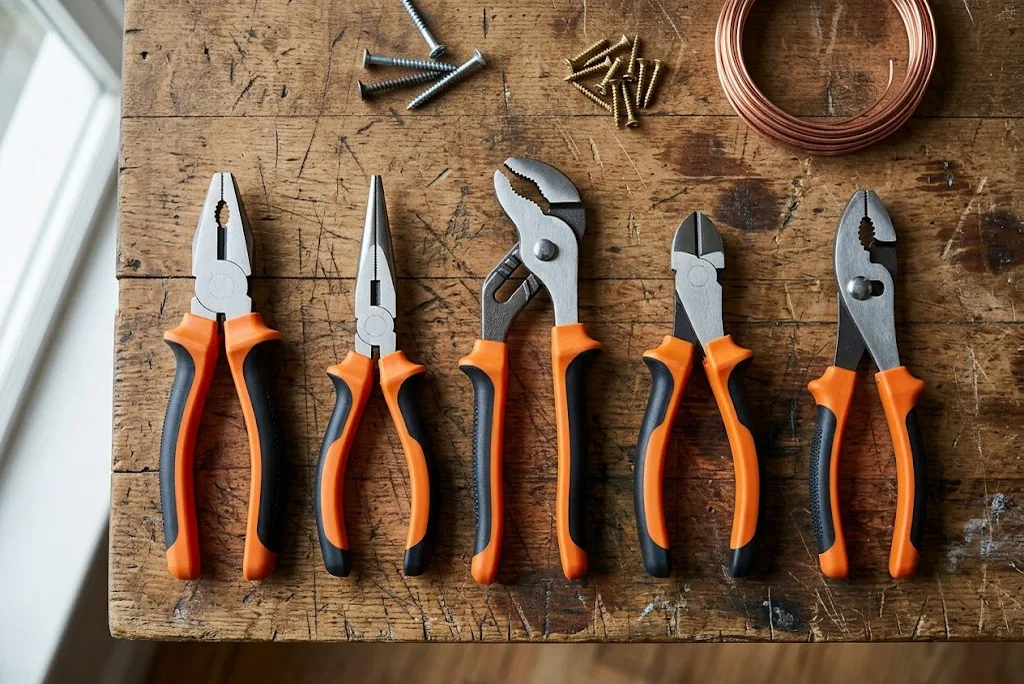
Most homeowners need five pliers: lineman's pliers for cutting and gripping, long-nose pliers for tight spots, tongue-and-groove pliers for pipes and big nuts, diagonal cutters for wire, and slip-joint pliers for general grabbing. Together they handle nearly every household repair.
What are the five pliers every homeowner needs?
Pliers are hand tools with two pivoting jaws that grip, bend and cut. That is a broad job description, and that is why there are so many kinds. Each type is shaped for a particular kind of work, and using the wrong one makes the job slower, harder and sometimes dangerous.
You do not need twenty. I've worked on houses for years, and almost every repair I see comes down to five types of pliers:
- Lineman's pliers: the heavy, all-purpose pair for gripping, twisting and cutting.
- Long-nose pliers: slim jaws for small, tight or fiddly work.
- Tongue-and-groove pliers: adjustable jaws for pipes, nuts and big round things.
- Diagonal cutters: for clean cuts through wire and small cable.
- Slip-joint pliers: the simple, general-purpose grabber.
Each one has a section below with what it is, what it does best, and the model I'd look at first. Three of the picks are specific, well-known tools. For the other two, I have given you a type and a search link, because there are plenty of good models and I would rather you pick a trusted brand that fits your hand.
I'm a licensed architect, and on remodel jobs I have used all five on the same afternoon.
Why you'll want them
You will use them constantly. Pliers are not special-occasion tools. They come out for a loose cabinet hinge, a bent hook, a stuck zip tie, a stubborn faucet cap or a sprinkler fitting. Owning the right ones makes small jobs feel easy.
They stop you from wrecking things. A kitchen knife on a screw, a wrench on soft pipe, or a rock on a staple. We have all done it, and most of those cost more than the tool you skipped. A proper pair of pliers saves a repair from becoming a bigger repair.
They cover plumbing, wiring and fence work. Tongue-and-groove pliers handle plumbing nuts. Lineman's and diagonal cutters handle low-voltage wire and fence wire. Long-nose pliers hold small pieces where fingers cannot go.
They last a lifetime if you buy decent ones. Good pliers are forged steel with a solid joint. Buy once, and your kids may inherit them.
Safety. A grip that holds a pipe nut steady means your hand stays out of the way. Cutters that cut cleanly do not spring and snap back at you.
Which pliers for which job
- Lineman's: twisting wire together, cutting heavy wire, pulling small nails, bending sheet metal.
- Long-nose: reaching into a tight junction box, holding a small screw, forming a loop in wire.
- Tongue-and-groove: a leaking trap under a sink, a stuck hose coupling, a large nut.
- Diagonal cutters: trimming zip ties, cutting wire flush to a surface.
- Slip-joint: holding a bolt head while you turn the nut, grabbing a hot or awkward part.
The pliers I would buy first, second and third
If your budget is tight, you do not need all five on day one. Here is the order I suggest.
- Lineman's pliers first. They do more jobs than any other pair. If you only own one, this is it.
- Tongue-and-groove pliers second. The first time a sink trap, hose fitting or pipe nut needs attention, you will be glad you have them.
- Long-nose pliers third. These are the pair that rescue fiddly jobs: hooks, small clips and wiring in a box.
- Diagonal cutters fourth. You can cut a lot of wire with lineman's pliers, but a dedicated pair cuts clean and flush and is easier on small wire.
- Slip-joint pliers last. They overlap with the others. Buy them if you want a cheap backup or something for the car.
Pliers versus the alternatives
Sometimes the right answer is not pliers at all. A wrench or socket is better for tightening a nut or bolt, because it grips the flats and does not round the corners. A proper wire stripper strips insulation without nicking copper. Locking pliers clamp and hold, which is a different job from squeezing and turning. Pliers are the flexible, do-most-things tool, and the others are the specialists.
Who it's for
- New homeowners starting a toolbox from scratch
- Renters who want a small, useful set for repairs and furniture
- DIYers tackling plumbing, wiring and fence work
- Anyone tired of using the wrong tool for the job
Who should skip it
- Pros who already own a full set. You likely have your favorites.
- People who want a one-piece multi-tool. A single pair of pliers will not do everything, so a multi-tool may suit better.
- Those who only need one specific job done. If you only need to change a bit of wire once, borrow a pair.
How to use them
Different pliers do different things, but the habits are the same. These steps cover the basics for any pair.
- Pick the right pliers for the job. Match the jaw shape to the work: long and slim for small items, adjustable for round parts, flat and wide for heavy grip, sharp for cutting.
- Wear safety glasses and gloves. Wire clippings and snapping parts fly. Eye protection is cheap and easy.
- Turn off power and water first. If you are working near wiring or plumbing, shut off the breaker or the water supply and test it. Never trust a switch alone.
- Open the jaws to fit. Set the jaws wide enough to grip the part fully. For tongue-and-groove pliers, slide to the right slot so the jaws are close to parallel when closed on the part.
- Grip as close to the work as you can. Close the jaws near the tips for fine control, or deeper in the jaws for more power.
- Squeeze and turn smoothly. Use steady pressure and avoid jerking. If a part will not move, stop and ask why before you add more force.
- Use cutters at a right angle. For wire, cut straight across, not at a twisted angle. Hold the loose end so it does not fly. Never cut hardened steel such as screws, bolts or piano wire with standard cutting jaws.
- Back off for stuck parts. If something is rusted or seized, spray a bit of penetrating oil and wait. Try again before using more force.
- Wipe and store. Clean the pliers, add a drop of oil to the joint now and then, and store them dry.
Tips from the field
- Do not use pliers as a hammer. They are not built for impact and the jaws can chip.
- Do not add a pipe to the handles for extra leverage. If you need more leverage, you need a wrench.
- Keep cutters for wire only. Cutting nails or screws dulls and nicks the edges.
- Mark your good pliers. A bit of colored tape makes it easy to spot your pair in a shared toolbox.
- Buy by feel. If you can handle them in a store, squeeze them. The right size feels balanced and does not pinch your palm.
Common mistakes
- Using lineman's pliers on soft metal pipe. The serrated jaws chew the surface. Use tongue-and-groove pliers, ideally with a rag around the pipe.
- Over-tightening with pliers. Pliers are good for holding and light turning. For final tightening, use a wrench so you do not strip or crush the fitting.
- Cutting hard wire with small cutters. The edges will chip. Match the cutter to the wire size, and use a bolt cutter for heavy material.
- Twisting the cutters sideways. Cut straight across, and keep the jaws square to the wire. Side pressure cracks the edge.
- Leaving them wet. Water gets into the joint and rust follows. Dry them before they go back in the box.
- Grabbing hot parts. Pliers conduct heat, and plastic handles can melt. Let hot items cool first.
What to look for when buying
You will find pliers for every budget. These are the points that separate tools that last from tools that fail.
Steel and forging. Look for forged alloy steel with hardened cutting edges. Cheap pliers use soft metal that bends or dulls quickly.
The joint. Squeeze the handles and open them slowly. The motion should be smooth, with no wobble or grinding. A loose joint means sloppy gripping and wears fast.
Jaw alignment. The jaws should meet evenly, and the teeth should line up. Misaligned jaws slip.
Handles. Dipped or molded grips make long jobs more comfortable. Make sure they do not slip when your hands are sweaty.
Size. Eight to nine inches is a good general size. Shorter is better for precision. Longer gives you leverage for plumbing.
Electrical rating. If you work near wiring, tools rated for electrical work add an extra layer of protection. But turn power off anyway.
Warranty. A long or lifetime warranty means the maker expects the tool to last.
Tier. Budget pliers will serve for occasional use. Mid-range models from known tool brands are the sweet spot for homeowners. Pro-grade models add refinements and last longer under daily use.
A note on sets. Plier sets are tempting, and some are a good deal from a trusted brand. The risk is that a set can bundle a few great pairs with a few you will never use, and the weakest pair is often the one that fails. If you buy a set, check that it includes the types in this article, and read how the maker describes the steel and the warranty.
Left-handed and small hands. Most pliers work for either hand. If you have small hands, look at shorter handles or a smaller reach. A pair that fits comfortably gets used more.
The table below summarizes the main specs to compare.
Key specs to look for
| Spec | What to look for |
|---|---|
| Steel quality | Forged, heat-treated alloy steel. Induction-hardened cutting edges stay sharp longer. |
| Joint | A smooth joint with no wobble. Hot-riveted or well-machined joints last longer than loose stamped ones. |
| Jaw alignment | Jaws should meet cleanly, with teeth that line up. Check this at purchase if you can. |
| Handle comfort | Dipped or molded grips that do not slip. Longer handles give more leverage, shorter ones more control. |
| Size | 8 to 9 inches suits general work. 6 inches suits electronics and tight spaces. 10 to 12 inches suits plumbing. |
| Insulation | Plain grips are fine for general work. Only rely on a pair rated for electrical work if you will work near live circuits, and turn power off anyway. |
| Warranty | A lifetime or long warranty is a sign the maker stands behind the tool. |
| Origin and brand | Proven brands cost more but often last decades. Budget brands work for light use. |
Where to get them
Here are the five, one at a time, with notes on why I'd pick each. Prices change often, so use the buttons to check today's price and read the current reviews on Amazon.
Lineman's pliers: the one to buy first
If you buy one pair, buy this type. I'm featuring the Klein Tools J2000-9NE, a 9-inch high-leverage pair made in the USA. According to the listing, the head and knives are induction hardened and the pair is designed to cut screws, nails and hard wire as well as grip and twist. Klein is a long-standing electrician's brand, and this model is a staple of jobsites.
Klein Tools J2000-9NE Lineman's Pliers, 9-Inch
- Grips, twists and cuts wire, and handles small nails and screws, per the listing
- High-leverage design from a trusted tradesman brand made in the USA
- The one pair to buy first if you only buy one
How we scored it
Usefulness 9/10 · Value 8/10 · Durability 9/10. This is our own opinion, based on reading specs and using similar tools. It is not an Amazon or customer rating.
How I use mine: pulling stubborn staples, twisting fence wire, cutting a bolt-on bracket's overlong screw to length, and pulling a bent nail out of old framing. It is not a delicate tool, and that is the point. Keep it in the bottom of the bag and it never complains.
Long-nose pliers: for tight spots
When a bolt or a wire is somewhere your fingers cannot go, long-nose pliers get in. I'm featuring the Klein Tools J203-8, an 8-inch long-nose with a side cutter and extended handles. It is a good all-round pair for small bends, electrical boxes and picking up dropped parts.
Klein Tools J203-8 Long Nose Pliers, 8-Inch
- Slim jaws reach into tight spaces, small bends and electrical boxes
- Built-in side cutter trims wire without switching tools
- Extended handles give more reach and leverage
How we scored it
Usefulness 8/10 · Value 8/10 · Durability 9/10. This is our own opinion, based on reading specs and using similar tools. It is not an Amazon or customer rating.
Why long-nose pliers earn a place: they are the tool for jobs where your fingers are too big. Think of setting a small cotter pin, bending a loop in wire for a picture hanger, retrieving a screw that dropped into a cabinet, or straightening a bent contact in an appliance. If you have ever tried those with your fingertips, you know why.
Tongue-and-groove pliers: for plumbing and big nuts
These are often called by a brand name, Channellock, in the same way people say Kleenex. I'm featuring the Channellock 440, a 12-inch tongue-and-groove model with straight jaws. The long handles give you leverage on stuck fittings, and the adjustable jaws fit many pipe and nut sizes. The 12-inch size is big, so also consider a shorter size for tight spaces under a sink.
Channellock 440 Tongue-and-Groove Pliers, 12-Inch
- Adjustable jaws grip pipes, nuts and round objects of many sizes
- Long handles give strong leverage on stuck plumbing and fittings
- The classic pair behind most under-sink repairs
How we scored it
Usefulness 9/10 · Value 8/10 · Durability 9/10. This is our own opinion, based on reading specs and using similar tools. It is not an Amazon or customer rating.
A quick plumbing tip: when you grip a chrome or plastic fitting, wrap a rag or a layer of tape around it first so the teeth do not mark it. And always turn the water off before you loosen anything.
Diagonal cutters: for clean wire cuts
Diagonal cutters, sometimes called side cutters or dikes, are the right tool for snipping zip ties, trimming wire flush and stripping away small pieces. I'm not recommending one exact model here because several reputable brands make good ones. Look for a 6 to 7 inch pair with hardened cutting edges and a comfortable grip. The button below opens an Amazon search so you can compare current options.
Diagonal Cutting Pliers (6-7 inch)
- Cuts wire, zip ties and small cable flush and cleanly
- Small and light enough to live in a pocket or tool pouch
- A good pair costs little and lasts for years
How we scored it
Usefulness 8/10 · Value 9/10 · Durability 8/10. This is our own opinion, based on reading specs and using similar tools. It is not an Amazon or customer rating.
Slip-joint pliers: the simple grabber
Slip-joint pliers are the old-school general-purpose pair, with two jaw positions for small and medium grips. They are not as strong as lineman's pliers or as flexible as tongue-and-groove, but they are cheap, handy and perfect for a kitchen drawer or a glove box. As with the cutters, I'm pointing you to a search so you can pick a reputable brand that feels right.
Slip-Joint Pliers (8 inch)
- Two jaw positions grip small and medium round or flat items
- Simple and cheap, ideal for the kitchen drawer or glove box
- A decent backup when your better pliers are busy
How we scored it
Usefulness 7/10 · Value 9/10 · Durability 7/10. This is our own opinion, based on reading specs and using similar tools. It is not an Amazon or customer rating.
If you are building out a first toolbox, see the new homeowner toolkit or the first apartment toolkit for what to buy alongside your pliers.
Frequently asked questions
What is the single most useful pair of pliers?
Lineman's pliers. They grip, twist, bend and cut wire, and they handle small nails and screws. If you buy only one pair, make it that.
What is the difference between pliers and wrenches?
Pliers grip and squeeze with flexible jaws. Wrenches fit a specific nut or bolt head. Wrenches are better for tightening hardware, and pliers are better for holding, bending and cutting. Tongue-and-groove pliers sit in between.
Can I use pliers on a rounded or stripped nut?
You can grip it in a pinch, but pliers can chew the corners and make it worse. Use the right wrench or socket if you can, and keep pliers as a backup.
Are insulated pliers safe for electrical work?
Pliers rated for electrical work add a layer of protection, but they are not a reason to work on live circuits. Turn the power off at the breaker and confirm it is off with a tester before you start.
Do I need a set, or should I buy individual pliers?
For most people, buying individual pliers gives better quality for the money. Sets can be a fine deal if the brand is trusted. Check that each pair is a type you will use.
How do I care for pliers?
Wipe them clean and dry, put a drop of light oil on the joint now and then, and store them out of damp. Do not use them as hammers or cheater bars, and do not cut hardened steel with cutting jaws.
Related tools
 Measuring & LayoutLaser Distance Meter: The Tape Measure Upgrade Worth OwningA laser distance meter is a small handheld tool that shoots a laser at a wall and shows the distance on a screen.
 Outdoor & GardenPick Mattock: The Digging Tool for Ground a Shovel Cannot BreakA pick mattock is a heavy digging tool with a pick on one side and a flat chopping blade (an adze) on the other.